
Only 20% of the world's employees feel engaged at work, according to Gallup's latest global survey. The other 80% are just getting through the day, or are actively unhappy.
What would you do if you were rich enough never to work again? And what if you had to show up every day to a desk with nothing on it? Erik Gandini's documentary After Work (2023) opens with these two questions. Swiss television SRF has just aired it as Work, Work, Work – Über den Sinn und die Zukunft der Arbeit.
The film visits Armando Pizzoni Ardemani, heir to an Italian noble family. He mows the lawns and trims the hedge maze of his family's famous garden at Valsanzibio himself, though he could easily pay others to do it. It also meets Meqdad Al-Kout from Kuwait, where the constitution guarantees every citizen a job. He spent six years as an official translator for a ministry, sitting in a basement with almost nothing to do.
Midway through, Gallup managing partner Pa Sinyan gives the film its most sobering number. Of the roughly one billion people in the world with a full-time job, only 15% are engaged at work. That figure comes from Gallup's 2017 State of the Global Workplace report. Gallup has measured engagement every year since, so we checked where things stand today.
Three kinds of workers
Gallup sorts employees into three groups by how attached they feel to their work, their team and their employer.
- Engaged. Work gives them a good feeling. They are emotionally involved and want to do well.
- Not engaged. They feel no real bond with their job. They put in the hours, but not their best effort or their best ideas. Gallup stresses that they are not the worst performers, just indifferent.
- Actively disengaged. They are frustrated and resentful and feel that nobody at work cares about them. Their unhappiness spreads, and they can undermine the efforts of engaged colleagues.
When the film's figure was published, the second and third groups together made up 85% of the world's employees.
Then and now
Engagement has risen since the film's figure, but it has now slipped two years in a row. In 2025, 20% of employees worldwide were engaged, 64% were not engaged and 16% were actively disengaged.
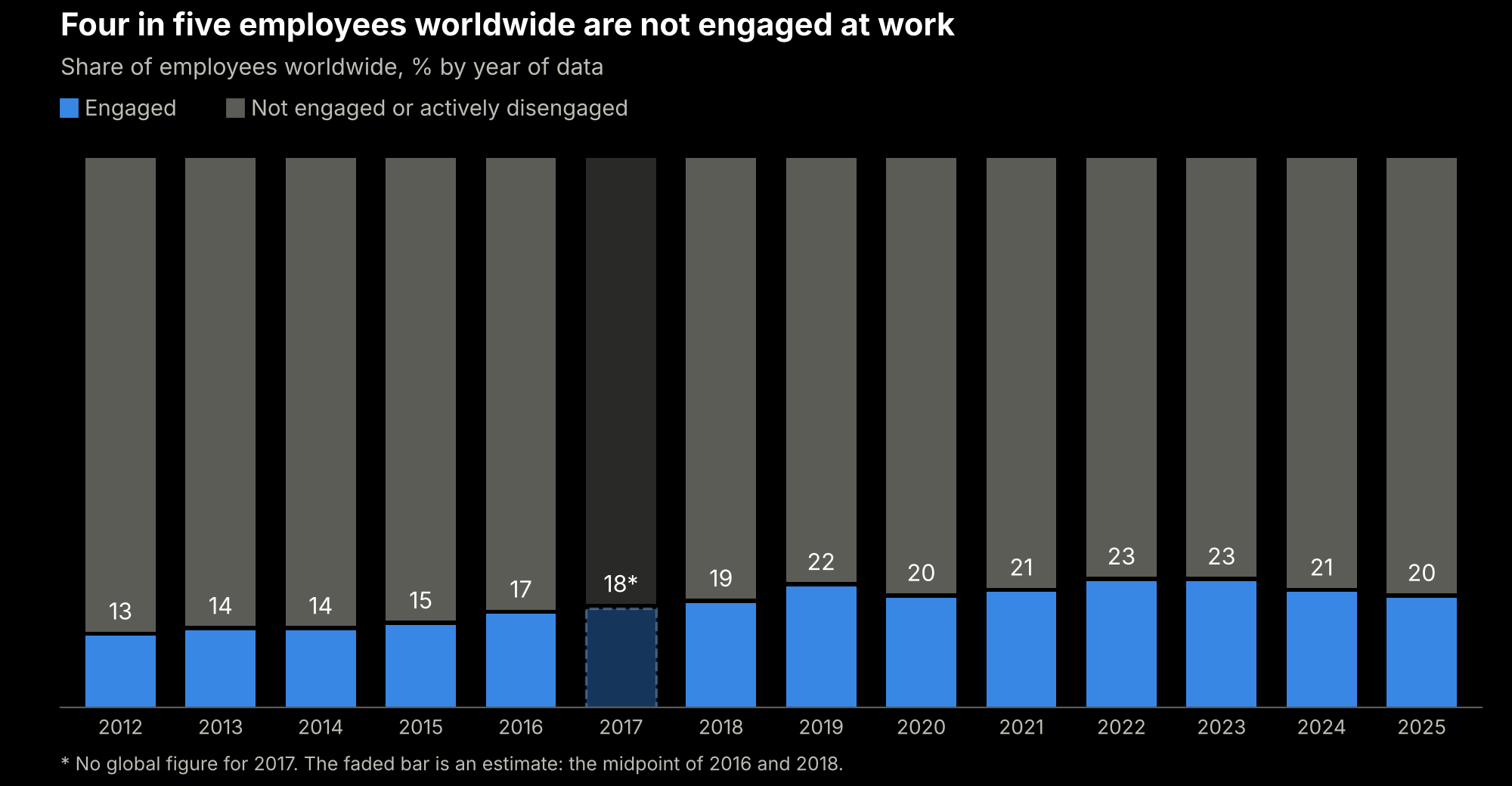
The drops in 2024 and 2025 were the first back-to-back declines since Gallup began measuring in 2009. No region improved in 2025, and South Asia fell the most, by 5 points. Each percentage point equals about 21 million employees.
The film's 15% comes from Gallup's 2017 report, which pooled survey data from 2014 to 2016. Gallup's current year-by-year series puts 2015 at 15% and 2016 at 17%.
The film's "one billion" is a round number. Gallup's own estimate of people working full time for an employer was about 1.3 billion in 2013 and about 1.5 billion by 2019.
Why it matters
Low engagement costs the world economy about $10 trillion a year in lost productivity, Gallup estimates. That is roughly 9% of global GDP.
Gallup traces most of the recent decline to managers. Their engagement fell from 31% in 2022 to 22% in 2025, including a 5-point drop in the last year alone. In South Asia, manager engagement fell 8 points in 2025 while the share of managers also shrank. Gallup points to hiring slowdowns and cuts to mid-level roles in India's IT sector, possibly driven partly by AI.
Engagement is also tied to how people feel outside work. In 2025, only 34% of employees worldwide were thriving in their lives. Some 40% had felt a lot of stress the previous day, and 22% had felt lonely for much of the previous day.
Work, AI and meaning
The film asks what work is for as robots and AI take over more tasks. Gallup's numbers sharpen that question: for most people, work is already more about income and routine than about meaning.
The film's two extremes make the point. Al-Kout had a secure job and a salary, yet the empty days left him filling the void with food and video games. Pizzoni Ardemani has no need to work at all, yet chooses hard physical work because it gives his days purpose. Having a job and finding meaning in it are clearly not the same thing.
That matters for the debate the film raises about a universal basic income, which tech figures such as Elon Musk have promoted. Supporters see it as a way to free people for more meaningful activity as automation spreads. Critics question whether societies will fund people who openly prefer the beach to the office, and whether income alone can replace the structure and status that work provides. The evidence on both sides is still limited.
Gallup's own conclusion is more practical: engagement depends heavily on how people are managed, and that can change. The film ends with a more personal question that each of us has to answer: what does my work mean to me, and what makes a life fulfilling?
About the data
The figures come from Gallup's annual State of the Global Workplace report, which draws mainly on the Gallup World Poll. The poll uses nationally representative samples of adults in more than 140 countries, mostly about 1,000 people per country. The 2025 data cover 263,810 respondents, of whom 141,444 were employed, surveyed from January to December 2025.
Sources
- Gallup: State of the Global Workplace 2026
- Gallup: Global Data Summary – State of the Global Workplace 2026
- Gallup: State of the Global Workplace 2017 (PDF)
- Gallup: Dismal Employee Engagement Is a Sign of Global Mismanagement (2017)
- Jim Clifton, Gallup: The World's Broken Workplace (2017)
- Gallup: Only 1.3 Billion Worldwide Employed Full Time for Employer
- Gallup: World Poll Methodology
- SRF DOK: Work, Work, Work – Über den Sinn und die Zukunft der Arbeit
- Nordisk Film & TV Fond: Interview with Erik Gandini on After Work
Read more articles
- Log in to post comments